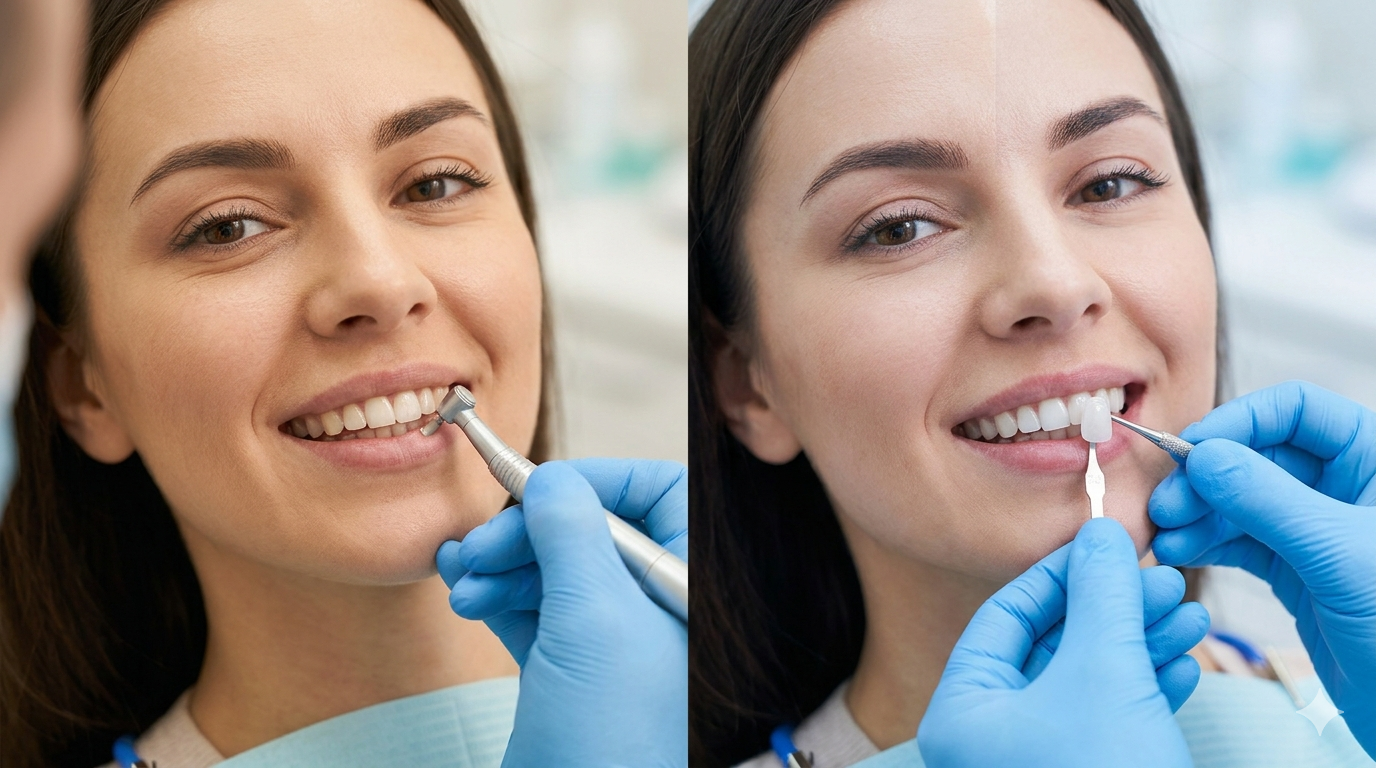
When it comes to improving small imperfections in your smile — like tiny chips, uneven edges, or slightly misshapen teeth — two popular cosmetic options often come up: tooth reshaping (enameloplasty) and veneers. Both can enhance your smile, but they differ significantly in cost, procedure, durability, and how much of your natural tooth is preserved.
Choosing the right one depends on how minor the issue is and what kind of long-term result you’re looking for.
What Is Tooth Reshaping?
Tooth reshaping, also known as enameloplasty or dental contouring, is a simple cosmetic procedure where a dentist removes very small amounts of enamel to adjust the shape or length of a tooth.
It is commonly used to fix:
- Small chips
- Slightly uneven teeth
- Pointy or irregular edges
- Minor overlaps
The procedure is quick, usually painless, and often completed in a single visit because enamel has no nerves.
Most importantly, it is a minimally invasive option that preserves almost all of your natural tooth structure.
What Are Veneers?
Veneers are thin, custom-made shells (usually porcelain or composite) that are bonded to the front surface of teeth to change their appearance.
They are used to correct:
- Discoloration
- Gaps between teeth
- Chips and cracks
- Mild misalignment
- Overall tooth shape and symmetry
Before placing veneers, a small amount of enamel is usually removed to ensure proper fit and natural appearance.
Unlike tooth reshaping, veneers are a more comprehensive cosmetic solution that can completely transform the look of a tooth.
Key Difference: Level of Change
The biggest difference between the two lies in how much correction is needed.
Tooth reshaping is designed for very subtle adjustments, where only minor enamel changes are required. It does not add material to the tooth — it only refines what is already there.
Veneers, on the other hand, are used when you need a visible aesthetic transformation, including changes in color, size, shape, or alignment.
Tooth Reshaping vs Veneers: A Clear Comparison
| Factor | Tooth Reshaping | Veneers |
| Invasiveness | Very minimal | Moderate (enamel removal required) |
| Procedure time | Single short visit | 1–2 visits (or more) |
| Cost | Lower | Higher |
| Best for | Minor chips, edges, small shape fixes | Color, shape, alignment corrections |
| Reversibility | Mostly reversible | Irreversible once enamel is removed |
| Aesthetic impact | Subtle improvement | Major smile transformation |
Which One Is Better for Minor Fixes?
For small cosmetic imperfections, tooth reshaping is usually the better first choice because:
- It preserves natural enamel
- It is quick and painless
- It is cost-effective
- It provides natural-looking results without overcorrection
However, reshaping has limitations. If too much enamel is removed or if the issue is more than just minor shaping, it may not be enough.
Veneers become the better option when:
- Teeth are severely chipped or worn
- There are gaps or discoloration
- You want a uniform, “smile makeover” result
- Multiple aesthetic issues exist at once
Can Both Be Combined?
Yes — in many cosmetic cases, dentists combine both techniques. For example:
- Minor reshaping is done first
- Veneers are then placed for symmetry and finish
This approach helps create a more natural and balanced smile while minimizing unnecessary enamel removal.
Risks and Considerations
Tooth Reshaping:
- Over-removal of enamel can cause sensitivity
- Not suitable for major corrections
- Results are permanent (enamel doesn’t grow back)
Veneers:
- More expensive
- Requires enamel removal (irreversible)
- May need replacement after several years
For minor cosmetic fixes, tooth reshaping is usually the simplest, safest, and most conservative option. It works best when you only need small refinements without changing the overall structure of your teeth.
Veneers, on the other hand, are ideal when you want a more noticeable transformation or need to correct multiple imperfections at once.
In short:
- Minor flaw → Tooth reshaping
- Smile transformation → Veneers
A dental consultation is the best way to decide, because the right choice always depends on how healthy your enamel is and how much change you actually need.